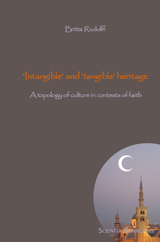
Britta Rudolff: ‘Intangible’ and ‘tangible’ heritage. A topology of culture in contexts of faith
Cover: Paperback
Price: 34,80 €
Pages: 363
Size: 148 x 210 mm
Published: December 2010
Publisher: Scientia Bonnensis
ISBN: 978-3-940766-36-6
Where is the borderline between an intangible and a tangible heritage expression? Is there a real difference between a cultural space and an associative cultural landscape? Would it make more sense to categorize heritage expressions along different concepts than their decree of physical materialization? How does this somewhat arbitrary division influence the way we perceive our heritage nowadays?
‘Intangible and tangible heritage – a topology of culture in contexts of faith’ presents a conceptual framework which could enable heritage professionals to approach cultural heritage in a more holistic understanding. The book emphasizes opportunities for a re-combination – in conceptual and practical terms – of two recently divided heritage concepts: the so-called ‘intangible’ and ‘tangible’ heritage. In arguing that the above division is not supportive to observing the dynamic construction and re-affirmation processes of heritage and identity, and further, that this division is a risk to the preservation of the shared heritage of humankind, the author emphasizes the importance of halting and redirecting the progressing divergence of the two fields.
With the concept of heritage topologies, the book introduces an innovative discourse to heritage studies and a new methodology to heritage identification. It is a fascinating tool for heritage studies students and scholars as well as heritage practitioners, for not only the analysis but also understanding and preservation of heritage expressions.

 Latest print publication